Using film to show quality control processes customers never see
Somewhere in your factory, right now, something remarkable is happening that no customer will ever witness. A machine vision system is scanning 600 vials a minute for cracks invisible to the human eye. A technician is torquing a component to a tolerance measured in hundredths of a millimetre. A finished product is being deliberately frozen, dropped, crushed or drowned to prove it can survive the real world.
You paid for all of that rigour. Your customers benefit from all of it. And almost none of them have any idea it happens.
That's a marketing problem hiding in plain sight, because the quality control processes you treat as back-of-house operations are some of the most persuasive, most watchable content your company owns.
Claims are cheap. Evidence is filmable.
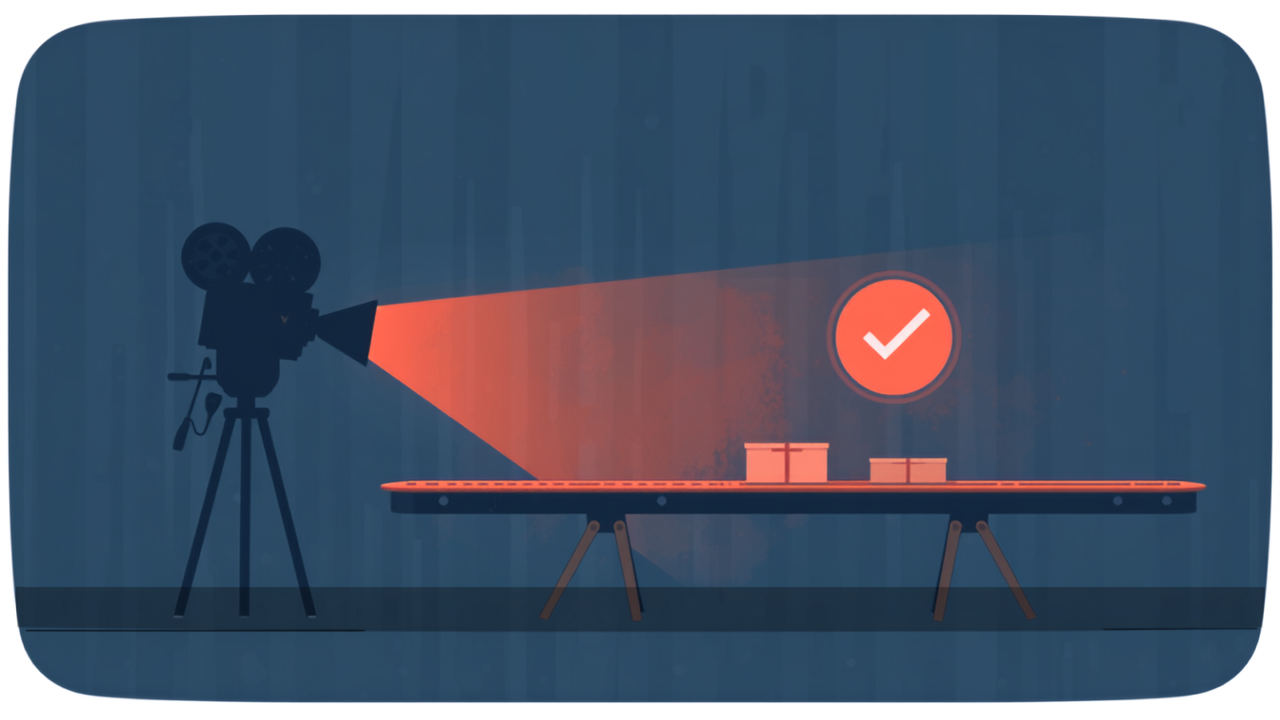
Every manufacturer says "quality is in our DNA". The phrase is so worn out it is a cliche, it communicates nothing. But video does something a claim can't. Video converts an abstract promise into observable evidence, and it is surprisingly watchable.
The buying behaviour backs this up. Roughly 70% of B2B buyers watch video during their purchasing journey, with the heaviest use in the consideration and vendor-evaluation stages — exactly when a prospect is deciding whether to believe you. And academic research (Montecchi et al., Psychology & Marketing, 2024) has found that perceived brand transparency drives purchase intention specifically because it builds trust first. Transparency is a mechanism through which trust, and buying, happens.
Check out Click2View's video production services
The internet already proved people will watch
If you doubt anyone wants to watch industrial processes, the internet has run the experiment for you, at massive scale.
How It's Made turned factory footage into three decades of family television. The Hydraulic Press Channel, a Finnish factory owner crushing things in his workshop press, has more than 10 million subscribers and over six billion views. Psychologists put the appeal down to our deep-seated preference for order, precision, repetition and completion. We want to get that "just right" feeling when a process resolves cleanly.
Quality control is natively in that genre. Precision, repetition, and a clear pass/fail reveal are exactly what "oddly satisfying" content rewards. Your inspection line doesn't need to be dressed up as entertainment. It already is entertainment, it's just never been filmed properly.
The technique is the story
The same QC process can be riveting or forgettable depending entirely on how it's shot. The world's best manufacturers have worked this out, and each has matched a filming technique to the nature of their process.
Fast and violent? Go high-speed. Rolls-Royce films blade-off and water-ingestion certification tests on its jet engines — controlled destruction, captured in slow motion, that says more about engineering confidence than any brochure. Boeing filmed the 787's wings being flexed 25 feet to 150% of maximum expected load. Samsung's reliability labs run folding rigs, tumble tests and drop tests under high-speed cameras and publish the results.
Tiny and precise? Go macro. Grand Seiko films the hand-assembly and inspection of its watches, each one tested for nearly 400 hours before it leaves the studio, through macro lenses that make a hairspring look monumental. Rolex shows its dive watches pressure-tested in a hyperbaric tank to depths 25% beyond their rating. Probe lenses that slide into a two-centimetre gap have made this kind of footage achievable on commercial budgets.
Invisible to the eye? Show the machine's view. Food-safety lines use X-ray imaging to find metal, glass and bone inside sealed packaging. The X-ray overlay itself makes gripping footage. Pharmaceutical vision systems inspecting vials at 600 per minute, semiconductor fabs generating half a million microscope images a month: when the defect can't be seen, film what the inspection system sees.
Built on craft? Put the human on camera. Hermès' documentary Hearts and Crafts follows the artisans who spend 15 to 24 hours of handwork on a single bag, catching imperfections by feel. Viewers came away saying they finally understood the price. When your quality process depends on judgment and skill, the QC engineer explaining what they're looking for, and what they reject, is the most credible spokesperson you have.
Restricted access? Get creative. ASML granted a science filmmaker rare cleanroom access to its EUV lithography machines and the resulting film reached some 10 million views. When Samsung couldn't practically film inside a working fab, it built a 15,000-piece Lego miniature of the line and animated it. The workaround became the story.
Yes, it's a hard shoot. That's partly the point.
Filming in these environments is genuinely difficult. Cleanrooms treat a camera crew as a contamination event and may need a full re-clean afterwards. Photolithography bays run under orange light that wrecks white balance. Factory floors demand ATEX-rated gear in explosive-atmosphere zones, flicker-syncing to the facility's lighting, full PPE for everyone including the director, and a dedicated spotter for the camera operator. NDAs for the entire crew are standard, and every worker on camera must follow safety protocol to the letter — one non-compliant frame undermines the credibility the whole film exists to build.
But the difficulty is precisely why this content works. Anyone can film a talking head. Footage from inside your test lab is footage a competitor can't fake, licence or stock-source. The barrier to entry is the moat.
How to start
Don't film everything. Pick one process with the strongest reveal — a visible pass/fail moment, a surprising level of precision, or a compelling expert who can talk about it. If you can't describe the money shot in one sentence, keep looking.
Then match the technique to the process, and cut for two audiences: a 60–90 second hero film for your website and sales conversations, and vertical 9–30 second cutdowns for LinkedIn and Shorts, with the reveal inside the first three seconds.
Buyers watch, transparency builds trust, and trust drives purchases.
The quality is already there. You've spent years engineering it. The only thing missing is a camera pointed at it.
Click2View produces film for complex B2B businesses across Asia — including the shoots other crews find too hard. If you've got a process worth seeing, talk to us.